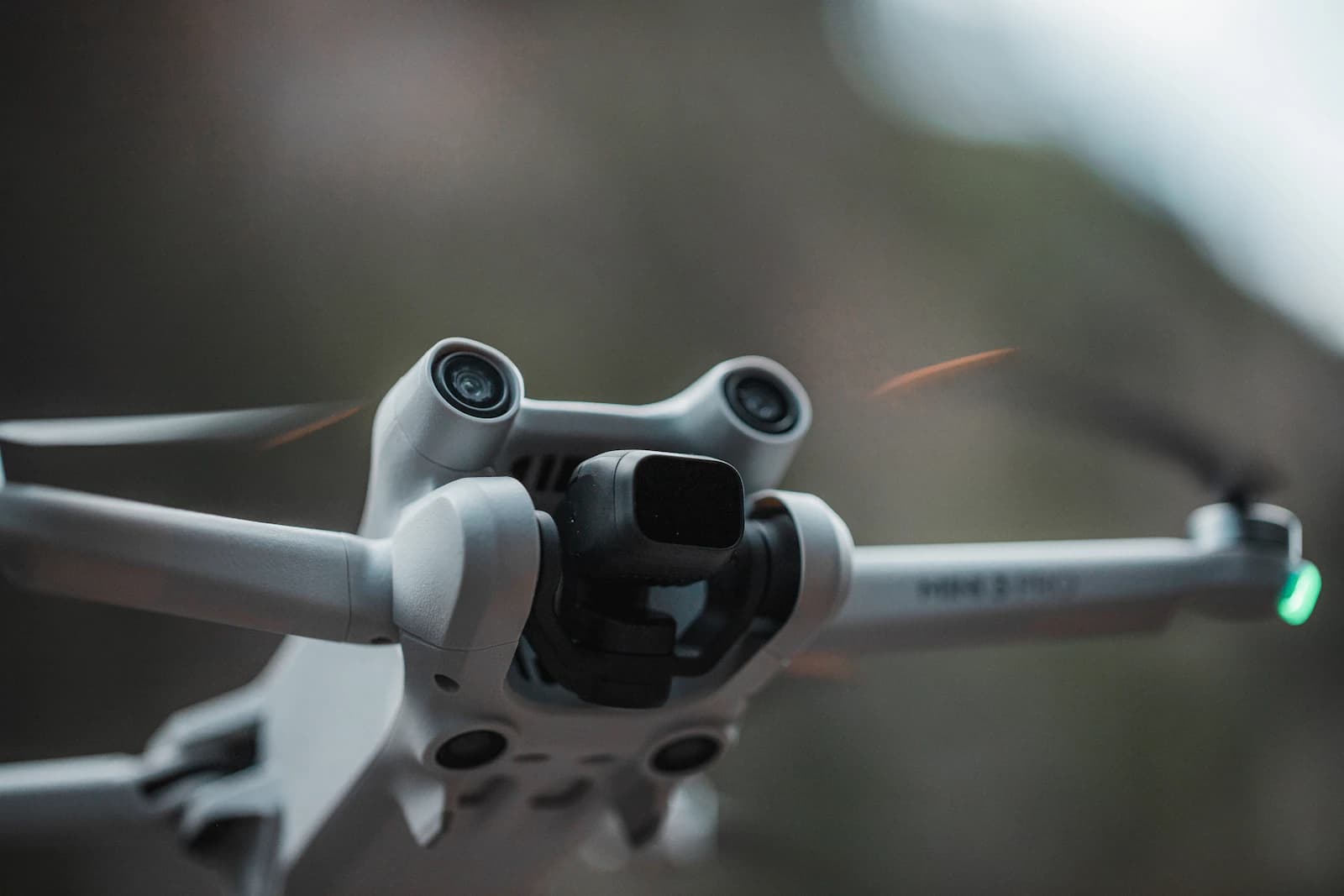
Most consumer drone cameras have a fixed or very narrow aperture range, which makes it practically impossible to hit a cinematic shutter speed in bright daylight without a neutral-density (ND) filter. Get the strength wrong and you either end up with a washed-out, overexposed clip or footage with harsh, stuttery "shutter judder."
Why drones need ND filters more than handheld cameras do
A DSLR can stop down its aperture to cut light, but most drone cameras sit fixed around f/2.8. Even dropping ISO to its floor of 100 on a clear midday shoot won't get you close to the standard "180-degree shutter rule" (shutter speed roughly double your frame rate — about 1/48–1/50s at 24fps) without several stops of overexposure. An ND filter cuts incoming light at the lens itself, so you can keep that shutter speed intact instead of chasing it with settings that hurt image quality.
Matching ND strength to the light you're actually in
As a rough baseline at 24fps, 1/50s, and ISO 100: ND16–ND32 tends to work for clear midday sun, ND8–ND16 for light cloud cover, and ND4–ND8 for overcast skies or the minutes right after sunrise or sunset. Those numbers shift with latitude and season, so treat them as a starting point — check the gimbal feed's histogram or zebra pattern before you commit to a strength, not after you've already recorded the shot.
Where variable ND filters fall short
A lot of pilots try to avoid carrying a filter case by relying on a single variable ND instead. The problem is mechanical: a variable ND stacks two rotating polarizing elements, and near its strongest setting (usually above ND32) that produces a visible dark X-shaped cross pattern across the frame — a polarization artifact that's especially obvious on the wide lenses drones typically carry. In practice, a set of fixed-strength filters (ND4/8/16/32/64) you swap out as conditions change holds up better than one variable filter pushed to its limit.
The mistake that catches even experienced pilots: skipping the seat check
Magnetic ND filters are convenient to swap mid-flight, but there are real reports of filters detaching during takeoff vibration or a sharp attitude change in gusty wind, then getting pulled toward the propellers. After mounting a magnetic filter, press it with a fingertip to confirm it's fully seated — and add "ND filter seated" as its own line on your preflight checklist rather than assuming a magnetic click means it's secure.
ND-PL (polarizer combo) filters: useful, but situational
An ND-PL filter combines ND with a circular polarizer, which cuts glare off water or wet rooftops and deepens color saturation nicely. On a wide-angle lens, though, that same polarization tends to darken the sky unevenly across the frame — a visible banding effect. It's a better fit for tighter shots of a specific reflective surface than for a broad panoramic sky shot, where the unevenness becomes obvious.
Storing and maintaining your filters
Shooting through a fingerprint or a speck of dust shows up as soft flaring in the highlights, so keep filters in individual slots in a hard case and clean them only with a microfiber cloth. Budget filters with a worn or missing coating often introduce a visible color cast (usually green or magenta) — if you're using older or lower-end glass, it's worth manually re-checking white balance before you start shooting rather than trusting auto white balance to correct for it.
Practical checklist
- Before takeoff, check the day's light (clear / light cloud / overcast) and bring the ND strength range that matches it.
- Confirm exposure on the gimbal feed's histogram or zebra pattern rather than guessing from the strength alone.
- Press-check any magnetic filter for a full seat before takeoff — every time, not just the first mount of the day.
- For wide sky shots, reach for a fixed-strength ND before a variable ND or ND-PL.
- Clean filters only with a microfiber cloth and store them separately to avoid scratches and fingerprint flare.