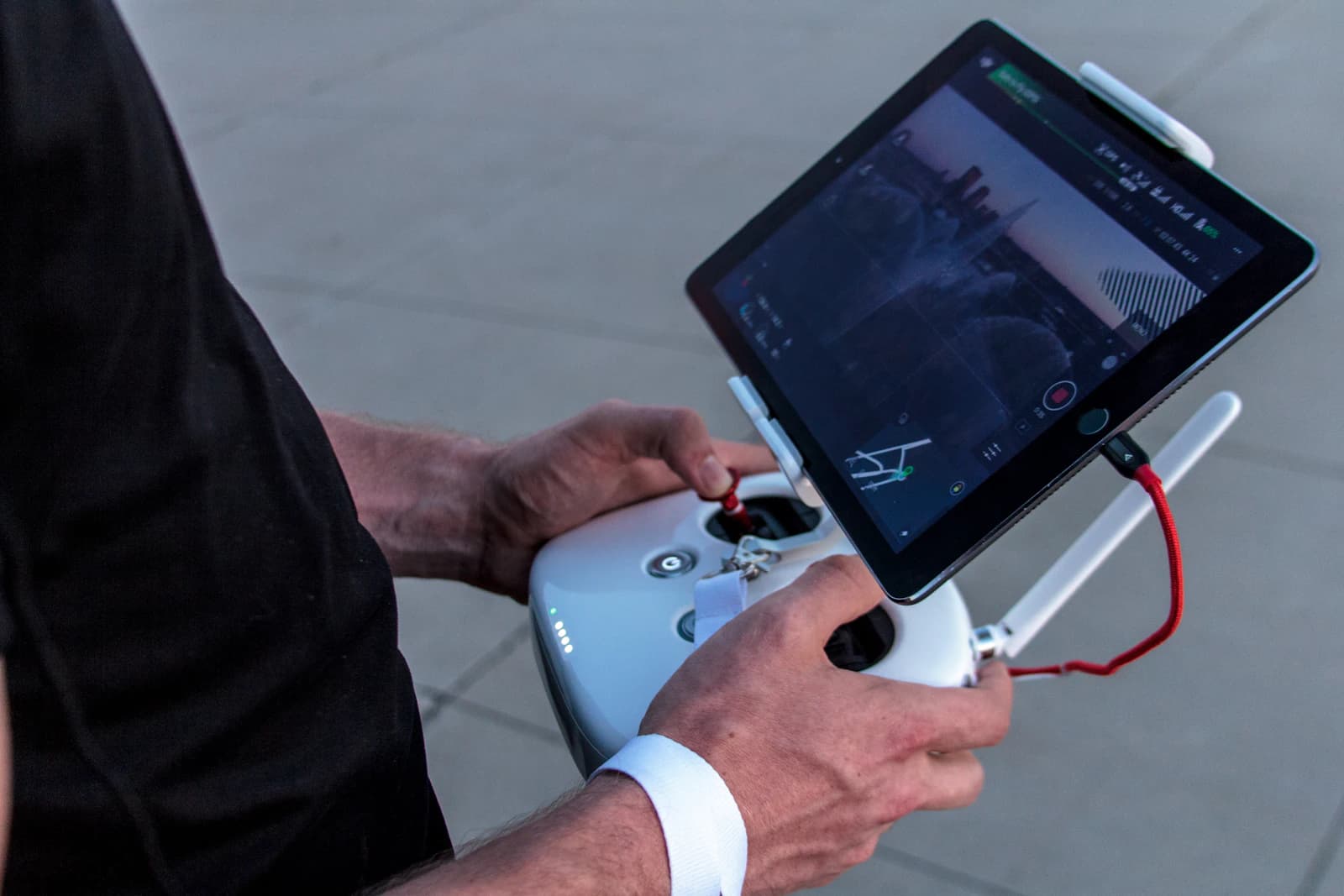
A drone's control link and video downlink use radio frequencies, and space weather is known to disturb some radio systems. The useful question for a pilot is which radio systems are actually affected, and which are not.
Key takeaways
- The solar wind is a continuous outflow of protons and electrons from the Sun. When it is fast or carries a strong magnetic field, it can drive geomagnetic storms.
- The radio effects that NOAA and other agencies document are on HF radio (3 to 30 MHz), low-frequency navigation signals, and satellite navigation (GNSS) signals.
- None of the sources used for this guide says that solar activity jams the 2.4 GHz or 5.8 GHz links that consumer drones use. Do not blame the sun first for a weak control link.
- What a pilot can realistically notice during strong space weather is a degraded satellite position or compass behavior, not necessarily a broken radio link.
- Everyday causes such as obstacles, antenna orientation, and local electromagnetic interference are far more common explanations for link problems.
What the solar wind is
NOAA describes the solar wind as a continuous flow of mainly protons and electrons, in a state called plasma, carrying the Sun's magnetic field outward. Its speed varies: NOAA gives about 400 km/s for the slower equatorial wind and 500 to 800 km/s for fast wind from coronal holes. NOAA's summary is that high-speed winds bring geomagnetic storms while slow winds bring calm space weather. A coronal mass ejection is a different phenomenon, a cloud of plasma thrown out in an eruption, and NOAA reports that the fastest Earth-directed ones can reach Earth in 15 to 18 hours.
When this material and its magnetic field interact efficiently with Earth's magnetic environment, a geomagnetic storm results. NOAA says storms can create strong horizontal variations in ionospheric density that modify the path of radio signals and create errors in GPS positioning. The ionosphere is the layer of charged gas in the upper atmosphere, and it is the link between space weather and radio.
Which radio systems are affected
| System | Typical frequency | What the sources document |
|---|---|---|
| HF radio | 3 to 30 MHz | Radio blackouts after strong solar flares on the sunlit side (R-scale); degraded or blacked-out HF through polar regions during radiation storms (S-scale) |
| Low-frequency navigation | Low frequency | Degraded or disrupted during radio blackouts and severe geomagnetic storms |
| GNSS (GPS and similar) | About 1.2 to 1.6 GHz | Path delay and scintillation in the ionosphere, mainly at high latitudes and near the equator; rare solar radio bursts at GPS frequencies |
| Drone control and video links | 2.4 GHz and 5.8 GHz | Not listed in NOAA's scale tables or impact pages |
The GNSS frequency range is general knowledge and not stated on every source page. The key point of the table is the last row: the bands that most consumer drones use for control and video do not appear among the documented effects. For example, the manual for the DJI Mavic 3 Pro says its remote controller works at both 2.4 and 5.8 GHz, and notes that 5.8 GHz is not supported in certain regions.
Solar radio bursts and GPS
One effect that is documented at satellite-navigation frequencies is the solar radio burst. The Australian Bureau of Meteorology's space weather service says that interference to GPS from solar radio bursts is expected only a few times in each solar cycle (about 11 years) and only for a few minutes each time. During signal acquisition, a burst can reduce signal-to-noise ratio by 8 to 9 dB for typical handheld receivers, which can make acquiring satellites difficult, although an established lock is rarely lost. The same page describes a 2006 event at Learmonth Observatory that resulted in loss of lock with GPS satellites for around two hours.
That page concerns GPS signals. It does not address 2.4 GHz or 5.8 GHz drone links, so this guide makes no claim about them.
What this means for a drone's control link
Most of the documented radio effects involve signals that pass through the ionosphere (GNSS) or bounce off it (HF). A controller talking to a drone typically uses a short path near the ground. That is a general description of how these links work and not a claim from an official page, but it fits the absence of any documented 2.4 or 5.8 GHz effect.
The practical consequence is that the first thing a pilot is likely to notice in strong space weather is the aircraft's satellite positioning or compass, not the control link. If the aircraft reports weak GNSS, the DJI manual says it may switch to Attitude (ATTI) mode, in which it can be more easily affected by its surroundings, and that the aircraft may not return to the Home Point normally if GNSS is weak or unavailable. See what to do when drone GPS signal is weak for the response steps.
More common causes of link trouble
The DJI manual advises avoiding areas with high levels of electromagnetism, such as power lines, base stations, electrical substations, and broadcasting towers, and warns that tall buildings and large metal structures can affect compass and GNSS accuracy. Other everyday causes of a weak link include:
- Obstacles between the antennas, including terrain, trees, and buildings.
- Poor antenna orientation or a controller held at a bad angle.
- Crowded radio environments in cities or at events.
- Long distances close to the maximum range of the system.
Space weather is a possible, but comparatively rare, explanation for a navigation problem. It should not be the first guess for a link problem.
Common mistakes
- Assuming that any video glitch on a high-Kp day is caused by the solar wind.
- Skipping the normal checks (antenna, location, interference) because "space weather" is an easy explanation.
- Reading only Kp. A flare can affect the sunlit side without any change in Kp; see NOAA space weather scales explained.
- Treating a calm space weather forecast as a guarantee against interference from local sources.
Practical steps
- Check the current Kp value and the NOAA 3-day outlook before flights where precise positioning matters, and see avoiding flights during geomagnetic storms for how to use them.
- Keep the aircraft within visual line of sight, and set a conservative range. This is general good practice, and it also leaves margin if GNSS or the link degrades.
- If a warning appears, bring the aircraft back toward you instead of continuing outward, and be ready to take manual control.
- Use the FlyDroneMap dashboard for current Kp and wind context, but keep your aircraft's own status screens as the final authority.
FAQ
Can the solar wind jam my drone's controller?
None of the sources reviewed for this guide documents solar wind or flares jamming 2.4 GHz or 5.8 GHz control links. Documented radio effects are on HF radio, low-frequency navigation, and GNSS.
What is the difference between the solar wind and a solar flare?
The solar wind is a continuous outflow of plasma, while a flare is a burst of radiation that reaches Earth at the speed of light. A coronal mass ejection, which can accompany a flare, is a separate cloud of plasma that takes hours to days to arrive.
Which signal is more likely to be affected, control link or GPS?
The sources point to GNSS signals rather than the control link. Ionospheric disturbances can delay or scramble GNSS signals, especially at high latitudes.
Should I fly during a geomagnetic storm?
That depends on your aircraft, mission, and local rules, and no guide can decide it for you. If you do fly, expect that GNSS and compass behavior may be less reliable and plan a manual fallback.
Sources and further reading
- NOAA Space Weather Prediction Center — Solar Wind
- NOAA Space Weather Prediction Center — Geomagnetic Storms
- NOAA Space Weather Prediction Center — NOAA Space Weather Scales
- Australian Bureau of Meteorology Space Weather Services — GPS Interference By Solar Radio Bursts
- DJI — Mavic 3 Pro User Manual
- NOAA Space Weather Prediction Center — Space Weather and GPS Systems