Most pilots treat rain as the trigger to land near a storm. By the time rain starts, the more dangerous parts of a thunderstorm may already have arrived.
Lightning can strike long before the storm looks close
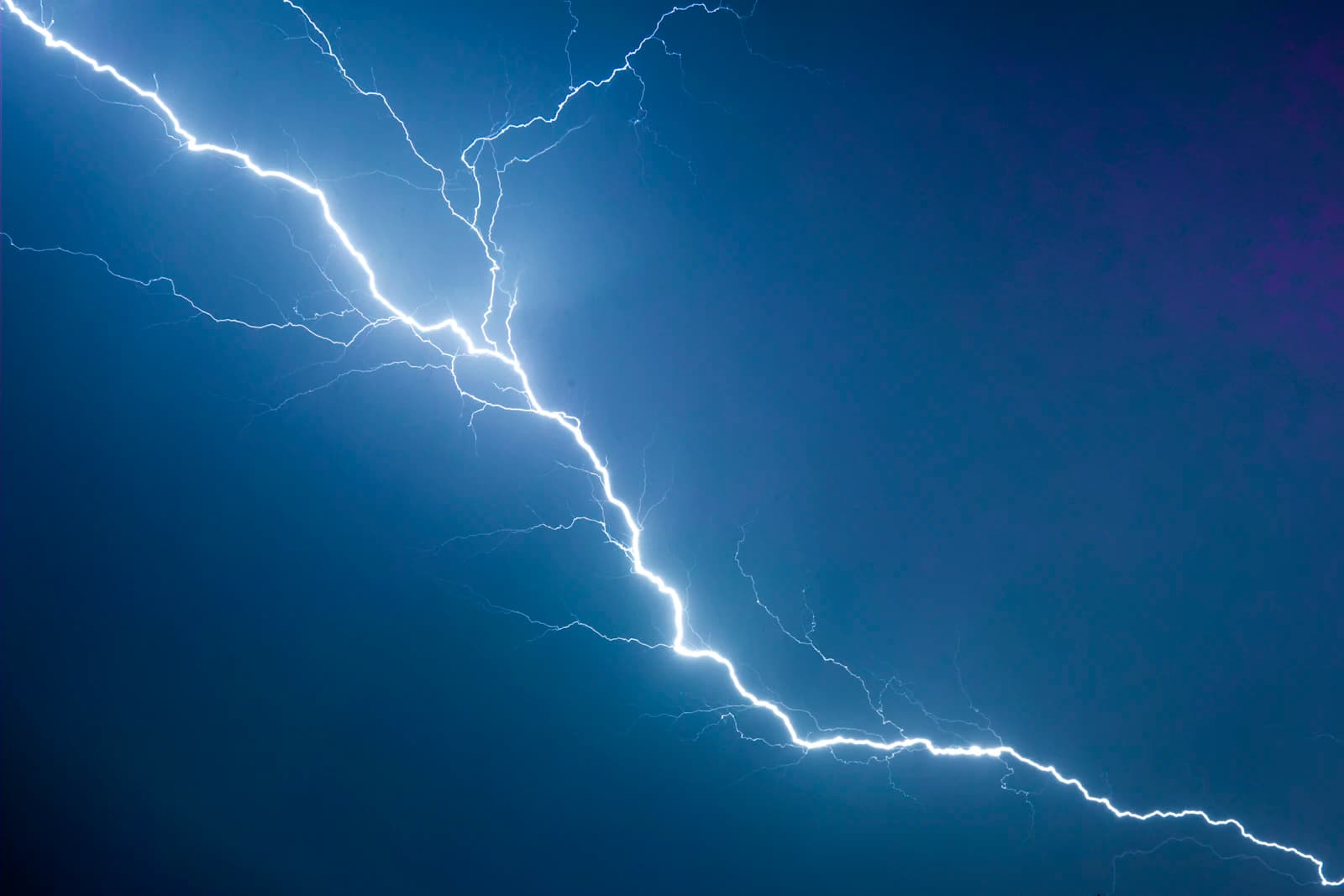
A "bolt from the blue" is a documented phenomenon, not a myth: lightning can travel outward from the parent thunderstorm cloud and strike ground roughly 10 miles (about 16 km) away, sometimes under a patch of clear or lightly clouded sky. A distant anvil cloud that looks harmless overhead can still be feeding a strike zone that reaches your launch site. The standard outdoor-safety guideline — the "30-30 rule" — applies directly to flying: if the gap between seeing a flash and hearing thunder is 30 seconds or less, the storm is already within striking range, and you should be on the ground, not mid-shot.
The gust front usually arrives before the rain
Thunderstorms push a wedge of cold, dense outflow air ahead of themselves along the ground, known as a gust front. This is why the wind can jump sharply — sometimes by 30 km/h or more within seconds — well before a single drop of rain reaches you. A drone holding steady in light wind can suddenly be fighting a strong, gusty headwind it wasn't trimmed for, right as visibility and light are also dropping. Waiting for rain as your cue to land means you may already be flying through the most turbulent part of the event.
Storm-generated radio noise degrades your control and video link
Lightning discharges produce broadband electromagnetic noise (often called "sferics") across a wide range of radio frequencies, including bands close to those used for drone control and video transmission. Pilots sometimes notice video static, added latency, or a shortened effective control range near an active storm even before any rain or strong wind arrives — a sign the storm is closer, in radio terms, than it looks visually. Treat any unexplained link degradation near building storm clouds as a reason to bring the aircraft back immediately rather than pushing to the edge of its range.
You, standing on the ground, are often the bigger risk
A small multirotor in the air is not a significant lightning target compared to a person standing in an open field holding an elevated metal or carbon-fiber controller and antenna. Open areas — parks, beaches, hilltops, sports fields — are exactly where drone pilots tend to launch from, and exactly where a person is most exposed during a thunderstorm. Once you've landed, don't stand around packing up slowly in the open; move toward a vehicle or substantial shelter and finish stowing gear there.
The common mistake: treating rain, not lightning risk, as the deadline
The most frequent error isn't ignoring an active storm overhead — it's continuing to fly a distant, visually impressive storm cell because "it hasn't reached us yet." Distance estimated by eye is unreliable, especially with tall cumulonimbus towers that can appear farther away than they are. Once thunder is audible at all, treat the flight as over for now, not paused until the rain arrives.
Practical checklist
- If you can hear thunder, you're within lightning range — land now, and don't relaunch until at least 30 minutes after the last thunder you heard.
- Watch for towering, anvil-shaped cumulonimbus clouds even under clear sky overhead — lightning can strike well outside the visible rain shaft.
- Land before an approaching storm's gust front arrives, not after — the sudden wind shift is often more dangerous to the aircraft than the rain that follows.
- Treat unexplained video static or control-range loss near a storm as an early warning sign, not just interference to fly through.
- After landing, move to a vehicle or solid shelter to pack up rather than lingering in an open field with elevated gear in hand.